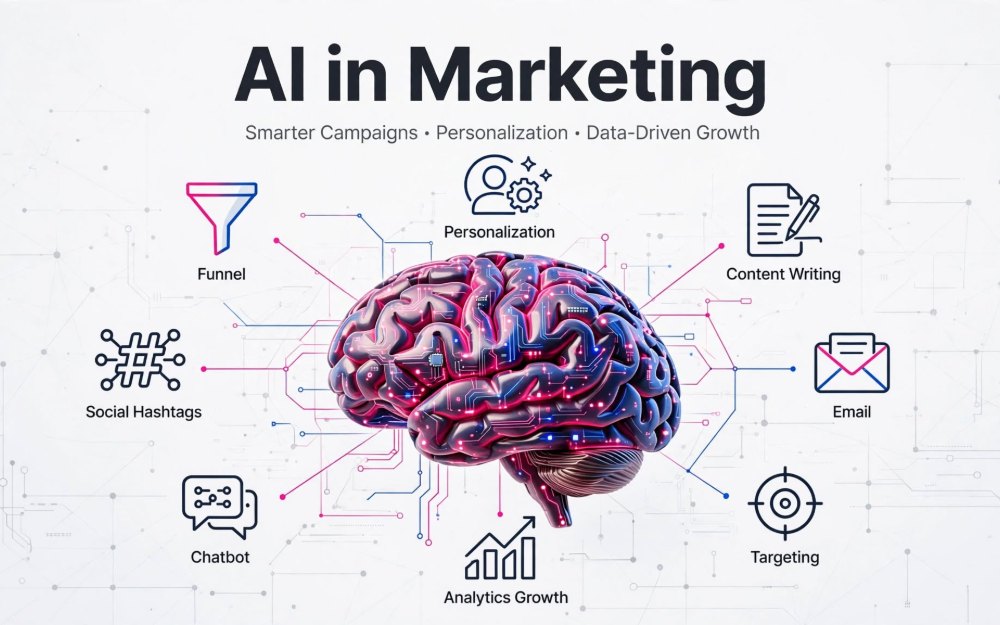
AI has not changed what marketing has to achieve. It has changed the cost of producing and testing options, which changes where a team should spend its judgement. The useful question is not whether to use AI but which specific tasks to give it.
Where the gains are real
Creative volume
Producing fifteen ad variations instead of three. More variants tested means faster learning about what your audience responds to, at the same media spend.
First drafts
Outlines, meta descriptions, product copy variations, email subject lines. Editing a mediocre draft is faster than starting empty.
Audience and data work
Clustering enquiry data, summarising hundreds of reviews, spotting which search terms cluster into a new service page.
Localisation
Producing Hindi and English versions of the same campaign, and adapting tone per platform without three separate writers.
Where it quietly costs you
Three failure modes show up consistently. The first is sameness: everyone prompting the same models converges on the same phrasing, so AI-heavy brands start sounding identical and stop being memorable. The second is unverified specificity — generated copy states numbers, claims and comparisons that were never true, and in regulated or reputation-sensitive categories that is a real liability. The third is strategic drift: AI is good at producing more of what you asked for and bad at telling you that you asked for the wrong thing.
AI lowers the cost of producing marketing. It does not lower the cost of being wrong about who you are talking to.
What buyers now do differently
The bigger shift in 2026 is on the buyer's side. A meaningful share of purchase research now starts with an assistant rather than a search box, and the assistant returns one composed answer with a few named sources instead of ten links. If your business is not one of the named sources, you are not in the consideration set at all — and unlike a low ranking, you cannot see it happening in your analytics.
This is why answer engine optimisation has moved from a curiosity to a line item: structured content, consistent business facts across the web, schema markup, and specific factual claims a model can safely quote.
A sensible division of labour
- Give AI: variation, first drafts, summarisation, resizing and reformatting, data clustering, repetitive production.
- Keep human: positioning, the core message, offer design, any factual claim, client-specific insight, and the final edit.
- Never automate: responses to complaints, pricing conversations, and anything published without a named person reading it first.
How to adopt it without degrading your brand
Start with one workflow, not a platform. Pick the task that is both repetitive and low-risk — usually ad variant production or meta descriptions — and measure whether output quality holds at the higher volume. Write down your brand's voice rules so every generated draft is edited against a standard rather than a mood. Keep a human sign-off on everything that carries your name, and audit a sample monthly for accuracy and sameness.
Frequently asked questions
Will AI content hurt my search rankings?
Search engines penalise unhelpful content, not the tool that produced it. Generated content that is accurate, specific and genuinely answers the query performs fine; generated content produced at volume to fill a calendar does not.
Can AI replace a marketing agency?
It replaces parts of production. It does not replace the decisions about what to say, to whom, and what to stop doing — which is where most marketing budgets are actually won or lost.
What should a small business adopt first?
Ad creative variation and answer-engine-ready content structure. Both produce measurable change within weeks and neither requires new tooling budget.