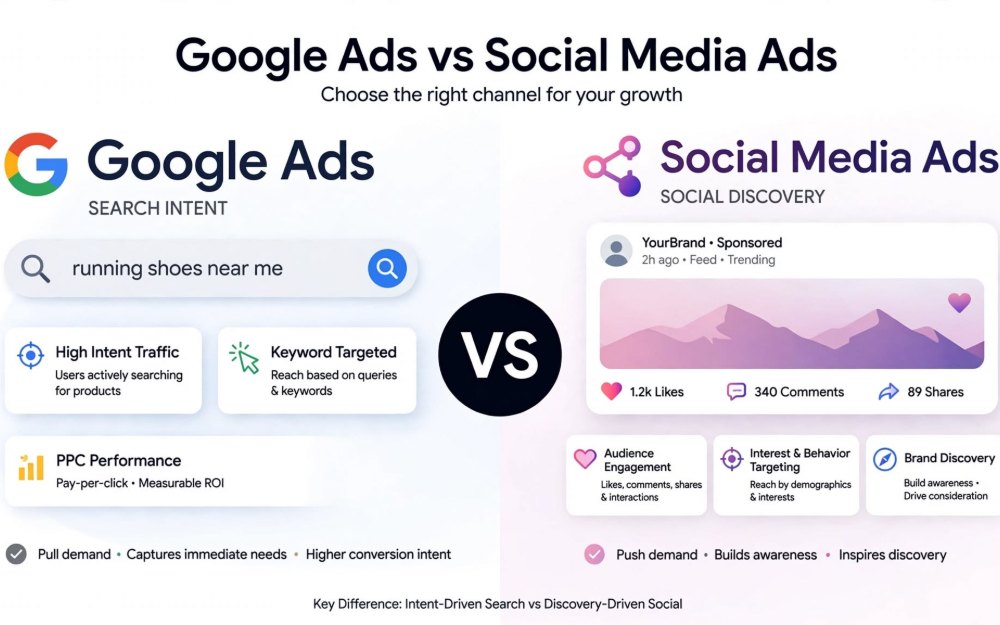
The two channels do different jobs, and most budget arguments are really a disagreement about which job the business needs right now. Google Ads captures demand that already exists. Social ads create demand that does not. Deciding starts with one question about your category.
The question that decides it
Are people already searching for what you sell? If your category has established search volume — plumbers, dentists, packers and movers, CA services, coaching classes — demand exists and Google Ads is the faster path to enquiries. If your product is new, discretionary, or something buyers do not know to look for — a new restaurant concept, a lifestyle product, a service category most people do not know exists — there is nothing to capture, and social is where you start.
What Google Ads is good at
- Intent that is already formed. The user is telling you what they want as they search for it.
- Short paths to enquiry — often the same session.
- Clean measurement against keywords and search terms.
- Local commercial queries, where "near me" behaviour is strong.
Its limitation is ceiling. You cannot buy more demand than exists in the search volume, and once you own the transactional terms, further spend buys progressively worse intent.
What social ads are good at
- Reaching people who have not thought about your category today.
- Visual categories where the product has to be seen to be wanted — interiors, food, fashion, property, events.
- Cheap audience building and retargeting pools.
- Testing messages fast, because creative iteration is cheap and feedback is quick.
Its limitation is patience. Enquiries arrive later and less predictably, and attribution is messier, which makes it easy to declare a working campaign a failure in week two.
How to split the budget
Established demand, need leads now
70% Google Search, 30% social retargeting. Capture first; use social to stay present with people who did not convert.
New or visual category
70% social, 30% Google on brand and the few transactional terms that exist. Create demand, then capture the search it generates.
Both, with a longer horizon
50/50 with strict separation of reporting. Judge Google on cost per enquiry and social on cost per qualified conversation.
Small total budget
Pick one. Splitting a small budget across two channels usually produces two campaigns with too little data to optimise.
Running both badly is more expensive than running one well.
The compounding effect most businesses miss
Social advertising raises search volume for your brand name. If you run a visual campaign for a month and then look only at social conversions, you undercount it — some of the return arrives as people searching your name on Google a week later. Track branded search volume as a social metric, not a Google one, or you will keep cutting the channel that feeds the other.
Frequently asked questions
Which is cheaper?
Social clicks are usually cheaper; Google enquiries are usually cheaper. Comparing cost per click across the two channels is meaningless because the click means something different in each.
How long should I test before deciding?
Four weeks on Google with clean structure, six to eight weeks on social — social needs time to exit the learning phase and build a retargeting pool worth measuring.
Can I just boost posts instead?
Boosting optimises for engagement, not enquiries. Use the ads manager with a lead or conversion objective; the difference in cost per enquiry is usually large.