
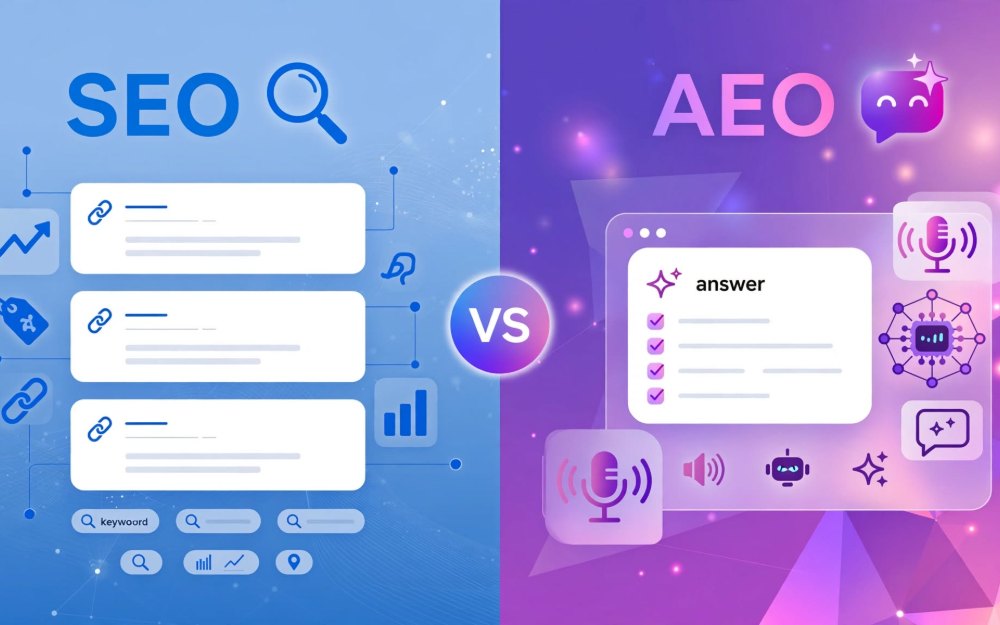
For fifteen years the goal of search marketing was a position on a results page. That goal has not disappeared, but it now sits alongside a second one: being the source an AI assistant reads out when someone asks a question. The two require different work, and most businesses are only doing half of it.
What SEO actually optimises for
Search engine optimisation is competition for a click. Google crawls your page, weighs relevance and authority against every other page targeting the same query, and awards a rank. Your reward is a listing the user must still choose. Everything traditional SEO cares about follows from that: keyword targeting, title and meta copy that earn the click, site speed, mobile rendering, internal links that pass authority to the pages you want ranked, and backlinks that prove other sites vouch for you.
The measurable outcome is traffic. You track impressions, average position, click-through rate, and the share of sessions that turn into enquiries.
What AEO optimises for
Answer engine optimisation is competition for a citation. When someone asks ChatGPT, Gemini, Perplexity or Google's AI Overviews a question, the model composes one answer and names a handful of sources. There is no results page to scroll and no second chance below the fold. You are either in the answer or you are not mentioned at all.
That changes what a good page looks like. Answer engines favour content that is easy to extract: a direct answer stated early, headings phrased as real questions, short self-contained paragraphs, defined terms, structured data, and factual claims that can be attributed. A 2,000-word article that buries its answer in paragraph nine can rank well and still never get cited.
The differences that matter in practice
Unit of success
SEO wins a ranked link. AEO wins a named mention inside a generated answer.
Content shape
SEO rewards depth and coverage. AEO rewards extractability — answer first, elaborate second.
Authority signal
SEO leans on backlinks. AEO leans on consistency: the same facts about you repeated across your site, your Google Business Profile, directories and third-party mentions.
Measurement
SEO has Search Console. AEO has almost no native reporting — you test prompts by hand and watch referral traffic from AI tools.
Why you cannot pick one
AI answers still draw most of their sources from pages that already rank. Weak SEO means the model never encounters you. At the same time, a page that ranks but reads like a brochure gives the model nothing quotable, so a competitor with a clearer page gets named instead. The two disciplines feed each other: ranking earns you candidacy, structure earns you the citation.
There is a commercial reason too. Users who arrive from a search result are still comparing options. Users who arrive after an assistant recommended you by name arrive pre-convinced. That second group converts at a noticeably higher rate, which is why the citation is worth chasing even while the traffic volume is small.
A practical checklist for doing both
- Open every page with a two-sentence direct answer to the question in the title, before any preamble.
- Write headings as the questions your customers actually type, not as marketing labels.
- Add Organization, LocalBusiness, Article and FAQPage schema so machines read your entities instead of guessing them.
- Keep your name, address, phone, services and founding details identical everywhere they appear online.
- Include specifics — numbers, dates, locations, named processes. Vague copy is unquotable copy.
- Build internal links between related articles so both crawlers and models see topical depth.
- Test monthly: ask the assistants the ten questions a buyer in your category would ask, and record who gets named.
Frequently asked questions
Does AEO replace SEO?
No. AEO is a layer on top of SEO. Answer engines source from indexed, ranking pages, so the technical and content foundations of SEO remain the prerequisite.
How long does AEO take to show results?
Faster than SEO in our experience. Restructuring pages that already rank can change citations within weeks, because you are reformatting authority you already hold rather than building it from zero.
Do small local businesses need this?
Increasingly, yes. Local queries — "best banquet hall in Lucknow", "interior designer near Gomti Nagar" — are exactly the kind assistants answer with a short named list. Being absent from that list costs you the enquiry entirely.