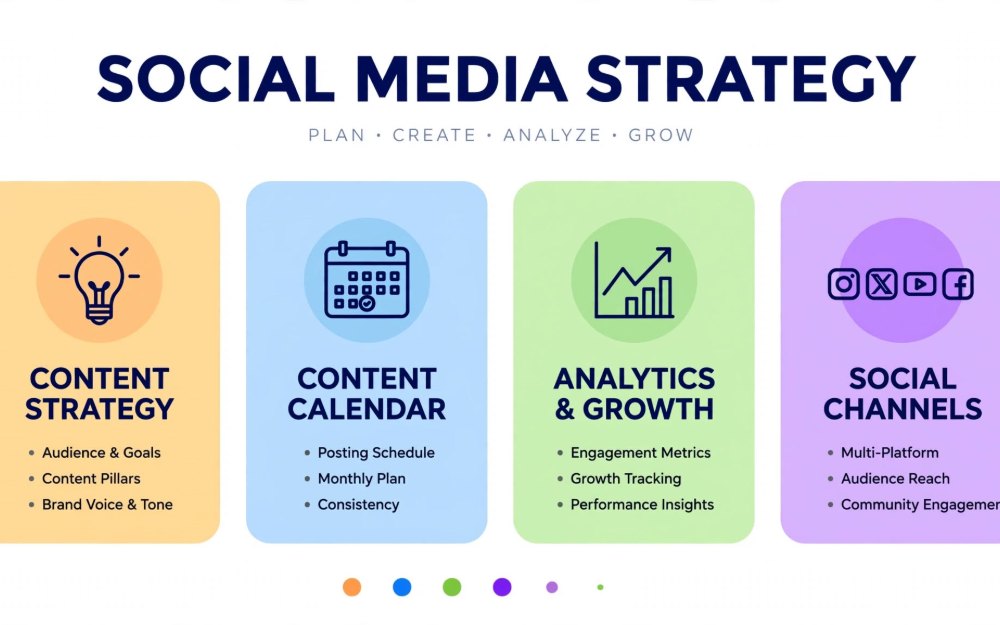
Most small businesses do not have a social media problem. They have a consistency problem caused by a plan that was never sustainable. The fix is to design the system around the capacity you actually have, not the capacity an agency deck assumes.
Pick two platforms, not five
Presence on five platforms at 20% effort loses to presence on two at full effort. Choose based on where your buyers already are and what you can produce. A banquet hall or restaurant belongs on Instagram and Google Business Profile. A B2B service belongs on LinkedIn and Google. A real estate business usually needs Instagram plus YouTube for walkthroughs. Everything else is a repost destination at best.
Build a four-format rotation
Deciding what to post is what kills consistency. Remove the decision by fixing the formats and rotating them. A rotation that works for service businesses:
Proof
Finished work, before-and-after, a delivered project. Your most persuasive and your easiest to shoot.
Process
How the work happens. Builds trust and separates you from competitors who only show outcomes.
People
Team, founder, a client's reaction. The posts that get saved and shared.
Point of view
A short, specific opinion about your category. The format that earns follows from strangers.
Four formats, one a week, and a month is planned. The rotation also makes shooting efficient: one site visit can produce a month of proof and process material.
Cadence: sustainable beats frequent
Three well-made posts a week, every week, outperform daily posting that collapses after a month. Platforms reward consistency of publishing more than raw volume, and audiences forgive a slower pace far more readily than a silent gap. Set a cadence you can hold through your busiest month of the year.
The best posting schedule is the one that still runs during your busiest week.
Batch production, publish live
Separate the two jobs. Shooting and writing happen in one batched session every two weeks. Publishing, replying and community management happen daily in fifteen minutes. Mixing them means a busy Tuesday costs you a post; separating them means it costs you nothing.
The two metrics to report
Follower count is not one of them. For a business owner, two numbers matter:
- Saves and shares per post. The clearest signal that content was useful rather than merely seen. Track the format that earns them and make more of it.
- Enquiries attributed to social. Profile link clicks, DMs that mention a post, WhatsApp messages from your bio. Ask every enquiry where they found you and log the answer.
Reach and impressions are diagnostic, not goals. They explain movement in the two numbers above; they do not replace them.
What to stop doing
- Festival and national-day graphics that mention your brand and say nothing. They cost design time and earn nothing.
- Reposting the same asset to every platform without reformatting. Each platform has a native shape and a native tone.
- Buying followers or engagement. It corrupts the only data you have.
- Posting only when you have an offer. Audiences tune out a feed that is entirely selling.
Frequently asked questions
How long before social media produces enquiries?
For a local service business with existing proof to show, typically two to three months of consistent posting before enquiries become predictable. Paid amplification shortens this; it does not replace the content.
Do I need to be on video?
On Instagram and YouTube, yes — reach is heavily weighted towards it. Video does not mean production quality; a clear vertical clip shot on a phone with good light outperforms a polished ad most weeks.
Should the founder appear on camera?
It reliably outperforms brand-only content in service categories, because buyers are choosing a person as much as a company. If the founder will not, a consistent team member works nearly as well.